The Three Tiers, Explained Simply
You need a contract signed. You open your e-sign tool, send the link, and the client clicks. Done — or is it? If your work crosses into the European Union, or if you handle certain regulated document types, the kind of electronic signature you used may matter as much as the fact that you used one. This guide breaks down the three tiers — Simple (SES), Advanced (AES), and Qualified (QES) — in plain language, so you can pick the right level without over-spending or under-protecting yourself.
Simple Electronic Signature (SES)
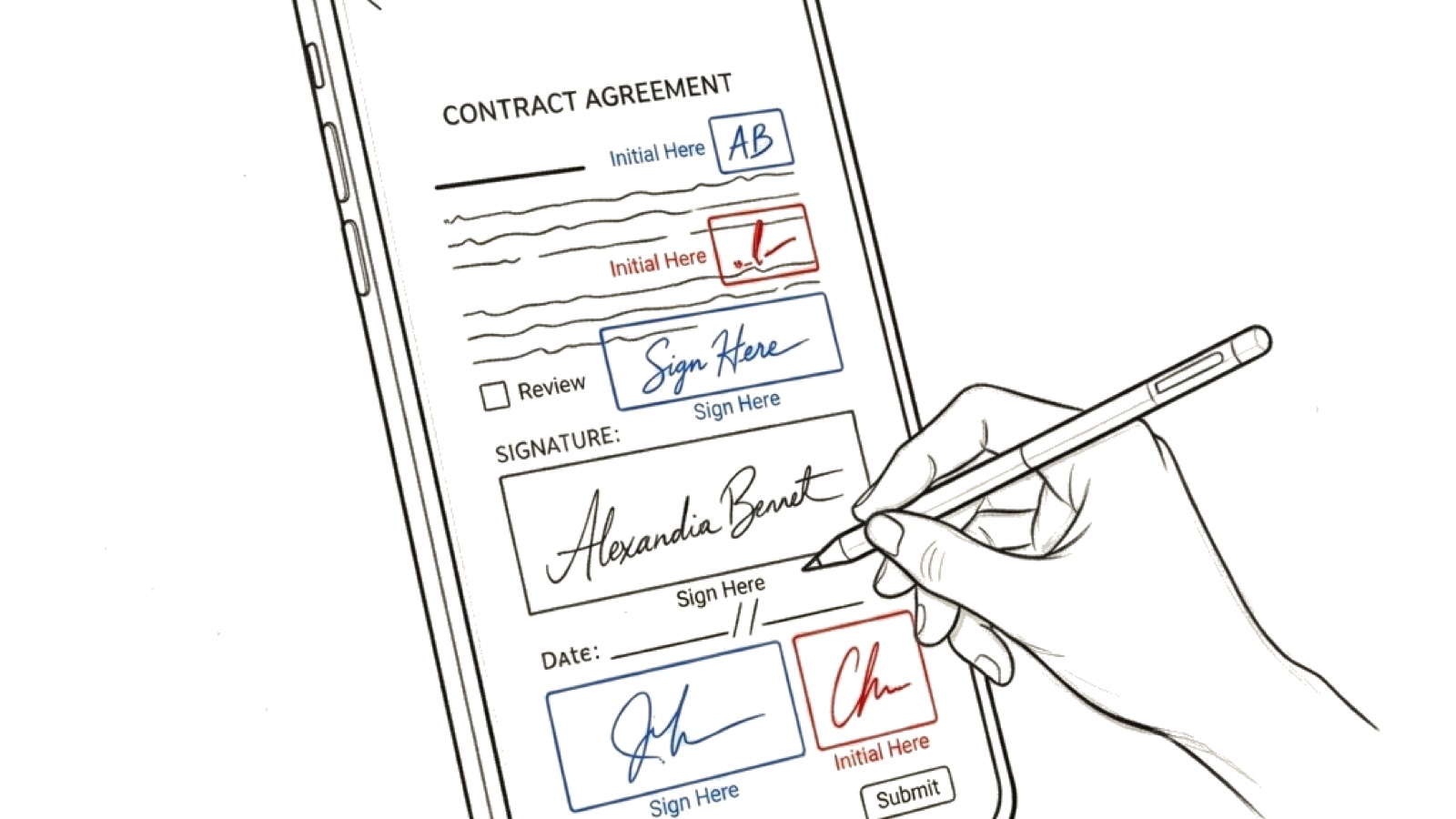
An SES is the most familiar form: a typed name, a ticked checkbox, or a drawn scribble on a touchscreen. Under eIDAS, an SES does not require any formal proof of identity at the signing step.[6] That makes it fast and frictionless — and it is the baseline that most everyday business documents use.
In the United States, this is largely the only tier the law contemplates. The ESIGN Act (15 U.S.C. §7001) states that a signature or contract cannot be denied legal effect solely because it is in electronic form.[12] UETA, adopted by 49 states (with New York maintaining its own similar act), applies the same principle to intrastate transactions.[13] Crucially, US law does not distinguish between SES, AES, or QES — the key legal test is whether the signatory intended to sign and consented to electronic records.[15] For most US-based freelancers and small firms, a well-documented SES workflow satisfies that test.
GSD e-sign signatures are legally binding and ESIGN and UETA compliant for US transactions.
Advanced Electronic Signature (AES)
AES raises the bar on identity. Under eIDAS Article 26, an AES must be uniquely linked to a verifiably identified signer and capable of identifying that signatory.[7] In practice, this means the platform must collect more than just an email address — identity verification (e-KYC) at enrollment provides significantly stronger evidence than email authentication alone if the signature is ever challenged.[8]
AES sits in a useful middle ground: stronger than a checkbox, less burdensome than QES. It is appropriate when you want a cleaner audit trail — think higher-value service agreements, sensitive HR documents, or cross-border contracts where a European counterparty may scrutinise the record. Typical per-document costs run from $2 to $5.[17]
Qualified Electronic Signature (QES)
QES is the top tier. Under Article 25 of eIDAS, a QES is legally equivalent to a handwritten signature.[1] That equivalence carries real weight in EU member-state courts and registries.
Reaching that level requires meaningful identity proofing. Before a Qualified Trust Service Provider (QTSP) issues a certificate, the signer's identity must be verified through methods such as a live video call, a pre-verified government eID, or an in-person check.
Sources
- L_2014257EN.01007301.xml
- Do Digital Signatures Require Proof of Identity? — IdentiGate Blog
- Do Digital Signatures Require Proof of Identity? — IdentiGate Blog
- Electronic signature: a practical guide to choosing the right eIDAS level
- eIDAS vs ESIGN Act: Document Signing Legality Explained (US vs EU 2026) — ScoutMyTool
- eIDAS vs ESIGN Act: Document Signing Legality Explained (US vs EU 2026) — ScoutMyTool
- AES vs QES vs SES: Which E-Signature Level Do You Need? (2026)
- AES vs QES vs SES: Which E-Signature Level Do You Need? (2026)
Ready to get signing done? Start free — 5 documents a month, no credit card — or browse the e-signature guides.